Freemasonry has long occupied a peculiar place in the public imagination. To some, it is a noble fraternity devoted to charity, moral instruction, and brotherhood. To others, it is a source of rumor, secrecy, and endless conspiracy. That tension is hardly new. In many ways, it is built into the nature of the fraternity itself. A private society, with private meetings, signs, symbols, and traditions, will always invite curiosity. And where curiosity is not satisfied, speculation quickly takes over.
Officially, Freemasonry presents itself as a philanthropic fraternity, committed to the universal fatherhood of God and the universal brotherhood of man. In its modern, organized form, it is generally traced back to 1717. Over the centuries, it has counted among its members presidents, patriots, soldiers, statesmen, scholars, and many other men whose names are well known in history. In America, especially, the list is impressive. Many of the founders were Masons, including several signers of the Declaration of Independence, and several presidents of the United States likewise belonged to the fraternity. It has also long been associated with charitable work on a very large scale.
And yet, despite all of that, Freemasonry has never escaped suspicion. Much of what the public thinks it knows about Masonry comes either from critics, enemies, or from those who have found in it the perfect material for dramatic storytelling. Some of the best books and movies, many of them my favorites, have played on that atmosphere. A good Masonic conspiracy has always made for a compelling plot!
For that reason, I was genuinely surprised to discover, in the course of my research on Moses Wilhelm Shapira and his missing leather manuscripts, that Freemasonry appears again and again in the story.
At first, I noticed the connections only in passing. A familiar name. A known Mason. A meeting place. A network. But the deeper I went into the Shapira saga, the more often those details surfaced. Over time, what first seemed incidental began to look more substantial. Several of the men connected with important stages of the story were Freemasons. Certain institutions and settings associated with the fragments overlap with Masonic circles. Perhaps most striking of all, the latest report thus far uncovered, places a substantial number of the fragments in a Masonic lodge before the trail goes cold.
Let me be clear. I am not suggesting that the Shapira affair involves some grand Masonic plot. That is not my point, nor is it my interest. My point is simpler and firmer. If one is serious about tracing the history, and perhaps the fate, of the missing Shapira fragments, the Masonic thread may prove too important to ignore. In fact, the cumulative weight of what I have found has convinced me that this avenue deserves serious and full investigation.
And that brings me to the more personal part of this post.
I am a Freemason.
My Masonic journey began in 1997, almost thirty years ago. That does not mean I have been equally active every year since then. Like many men, I have passed through periods of greater and lesser involvement. There were years when I was largely inactive. But in recent years, I have become very active, and Freemasonry has become for me not only a meaningful fraternity, but also a serious field of historical interest and research.
I am a Master Mason, a member of the Scottish Rite, 32°, a Shriner, and a Royal Arch Mason in the York Rite. I am also a member of the Philalethes Society and the Louisiana local Secretary for the Quatuor Coronati Correspondence Circle of Quatuor Coronati Lodge No. 2076, the premier Masonic research lodge in the world.
I mention this here because it matters.
What I have come to appreciate deeply in Freemasonry is not only the brotherhood, the quiet philanthropic work, and the fraternity’s respect for the Bible, but also the way it brings together men who might otherwise never sit together as brothers. I have attended a lodge in Israel, where I sat with Jewish, Christian, and Muslim Masons together. I have traveled to England and Germany, and I have corresponded with Masons in various parts of the world. All of this has reinforced for me that Freemasonry is a serious fraternity with a rich history, living traditions, and enduring networks.
My connection to Freemasonry is serious, and I approach Masonic research in much the same way that I approach biblical research. In both fields, my concern is with the historical and the objective. I want sources. I want records. I want names, dates, places, correspondence, proceedings, and verifiable facts. I have little interest in fantasy, inherited rumor, or speculation simply because it is intriguing. In both biblical and Masonic research, I want to separate what can be shown from what is merely said.
That is one reason this trail has my full attention.
I have already begun to investigate the Masonic connection to the Shapira saga. This is not merely an idea that has occurred to me in passing. It is already an active avenue of pursuit. And since the surviving path of the Shapira fragments passes through Masonic hands, Masonic institutions, Masonic meeting places, and Masonic records, it stands to reason that someone who knows that world from within may be in a particularly good position to recognize the clues, ask the right questions, and follow leads that others might overlook.
I do not mean that Masonry possesses some magical hidden key. I mean something much more practical than that. Fraternal networks leave traces. Lodges keep records. Proceedings are printed. Correspondence survives. Local traditions endure. Institutional memory often preserves what the wider world has forgotten or never knew.
For me, then, this is not a curiosity to exploit. It is a trail to test.
In a sense, this is something of a coming out for me. Those who know me personally, or who have followed some of my other writings and work, may or may not be surprised by it. Many, in fact, already know of my affiliation with Freemasonry. But I have not made my Masonic life public until now. Here, however, it bears directly on the subject of some of my most important research. If I am to speak plainly about the trail as I see it, then I should also speak plainly about why I am prepared and uniquely qualified to follow it.
Part of my reason for doing so is simply openness. Those who have followed my work should know this part of my life as well. But part of it is also practical. If this line of inquiry proves as significant as I believe it may, then it deserves to be pursued openly and seriously. And if any brethren, particularly those with knowledge of relevant lodges, archives, proceedings, or local traditions, can help illuminate this path, I would welcome that help.
I do not yet know where this road leads. But I do know this: the deeper I have gone into the Shapira saga, the more often Freemasonry has appeared, not at the edges of the story, but near its center. That repeated pattern is enough to persuade me that this is not a side note, but a matter worthy of full investigation.
For that reason, I can no longer treat this as a private interest. It is now part of the larger quest.
And that is something I wanted to say plainly.
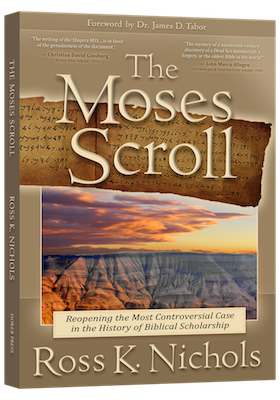
For those who have not read The Moses Scroll, here is a link. It is available on Amazon in paperback, hardcover, Kindle, and audio.
As an Amazon Associate, I earn from qualifying purchases.
Excellent article, Ross. Free and Accepted Masons and related groups are among the most misunderstood organizations in the World. I, too, am a proud Mason. The real tradition of Masons is one of self-improvement and support of those less fortunate. We accept men who believe in God and in an afterlife, regardless of religion. As with another Mason, the founder of United Israel World Union, David Horowitz, being one does not interfere with my Hebrew Faith at all.
David Tyler, Rome, NY
Brother Ross..
Verily I say that your honesty, integrity, dedication, work & words are very special indeed.
Sincere, potent thanks.
My Grandad left me a briefcase after his passing, containing a large, elaborate certificate that revealed he had been a master of some kind in the Cumbria Lodge, UK; & also contained books, including Bible’s, aprons of ceremony, & sheet music (he sung)
Never pursued or investigated further, & now live in Malta
.. & I’ll bet there are some interesting masons here!
Many thanks again,
keep on keepin’ on,
& Shalom,
Brother Ross
Ross, this is as fascinating as it is important. I am not a Mason and have no in-depth knowledge of the society, but as a historian of religions I do know the vital role it has played over the centuries on so many levels. One focus of my research, as you know, is the stream of Jesus followers that flowed through his brother James the Just, the so-called “Ebionites,” down into the 4th and 5th centuries CE. Some of your readers might know the work of Jeffrey Bütz, and his amazing book, and some, such as Jeffrey Bütz, in his very engaging book, The Brother of James and the Lost History of Christianity, which I highly recommend. Less known is the sequel, with the intriguing title: The Secret Legacy of Jesus: The Judaic Teachings That Passed from James the Just to the Founding Fathers. The two go well together, and the connections with the advocacy of “religious freedom” in America in 18th century is something I had never really considered. Let’s keep up our Quest! As a great teacher once said: In due time, we will reap, if we faint not.
Thx Dr Tabor!
Ross, your reflection adds a fascinating new dimension to the Shapira saga. The idea that the fragments may have passed through Masonic hands—not as part of a conspiracy, but through the ordinary mechanisms of fraternal record‑keeping—gives the story a depth most “Masonic mysteries” never achieve. If you ever do uncover the fate of the scrolls, that moment of realization would make a remarkable cinematic catalyst: a historian‑Mason discovering that the key to a long‑lost manuscript was preserved by the very networks built to safeguard memory and tradition. Whether or not the fragments reappear, this line of inquiry already feels like one of the most compelling intersections of biblical scholarship and Masonic history in years. Movie Title? “Modern Masonic Mystery: The Manifestation of the Moses Scroll”. 🤩😉👍🤗🤫🤩
Ross – I have been intrigued by the Masons since my father told me his father (of course, my Grandfather) was a Mason. My grandfather died when Dad was only 9 years old, and so Dad did not apparently learn about them from him. My grandfather became more real when Dad gave me my grandfather’s tattered Mason book. That is an important family genealogical fact that I have wanted to explore but have not. Perhaps his father and earlier generations were Masons. They go back to before the founding of our country.
I read your book on the scrolls (when James Tabor recommended it) and Jeffrey Bütz’s 1st book (also when he recommended it) and was hooked. I now need to read the sequel James cited above. I respect the Masons’ privacy but would like to explore my family’s involvement. Any advice you have would be appreciated.
Was Shapira a Mason?
No, not so far as I have discovered.
Ross, thanks for your balanced perspective on Freemasonry and for clearly separating speculation from documented facts and experience. While I am not a Freemason myself, your article helped me better understand why the fraternity has remained meaningful to so many men across cultures and generations. The emphasis on brotherhood, moral seriousness, charitable work, and historical continuity comes through clearly and convincingly.
What I find particularly admirable is the way you describe Freemasonry as a space where men of different backgrounds and beliefs can meet on common ground, without erasing their differences.
In a time when meaningful dialogue is often difficult, that commitment to fraternity, discipline, and shared moral inquiry is no small thing. Your insistence on evidence over rumor, and history over fantasy, also models an approach that deserves respect well beyond Masonic studies.
Good luck on the investigation of any possible Masonic connection to the Shapira saga. Who knows where that trail might lead.